
Posted15 Apr 2026
- In
Sleepers Awake Composer's Note
 Facebook
 Twitter
 More
MoreI have always felt opera characters share a quality with sleepwalkers, whose movements and speech are guided through the dreamlike world of the theater by invisible forces (the orchestra, a musical score). About halfway through Robert Walser’s dramolette “Sleeping Beauty”, a prince-like character asks whether the palace inhabitants he has just awakened aren’t in fact “Sleepwalkers, even in broad daylight?” Walser’s characters, even on the page, have a similar, uncanny operatic quality. This doubleness, as if there’s an inner logic to their motions and emotions, remains hidden from both the reader and the characters themselves as they meander through Walser’s enchanted world, half dreaming, half awake. Inspired by this same sensibility, the opera Sleepers Awake retells the familiar fairy tale of “Sleeping Beauty” in a way that further dissolves the border between sleeping and waking.
Sleepers Awake is also an exploration of the repetitive cycles of work and dreaming that structure our world. In the opera, a community awakens to face the drudgery of real life and drifts back asleep, only to awaken again. Are they in the same place or somewhere different? The opera centers this group (the chorus) as the main player in a story that unfolds musically in a series of tableau-like ensemble scenes. I created the libretto by adapting three Robert Walser texts (parts of the unusual 1920 dramolette “Dornröschen,” fragments from an article with the same title from 1919, and a fragment of one of his famous micro scripts from 1927) with Arthur Quiller-Couch’s early 20th-century rendering of the same fairytale. Verses adapted from the traditional 1599 hymn “Sleepers Awake” by Philipp Nicolai (translated by Frances Cox) were adapted and inset along the way. This process was guided by my close collaborator, director Jenny Koons, while Walser specialist Ron Sadan provided new translations and guidance on the selection of the Walser source material.
In Walser’s world, nothing is quite what it seems. Or rather, things often are two things at once: sleep can represent both ignorance and enlightenment; repetition can feel nightmarish or soothing. Our protagonist Thorn Rose — a rendering of Dornröschen, the Brothers Grimm’s name for “Sleeping Beauty” — is named in honor of such opposites existing side-by-side. Is this paradoxical world a puzzle to solve, a trap to escape, or simply a mystery to inhabit? The music — shot through with obsessive repetition, harmonic cycles, rhythmic labyrinths, and recurring motifs — asks similar questions. A counterpoint of musical styles, including evocations of the Medieval, the Baroque, the Classical, the 19th century, and the Minimalist, move forward and backward through time, accompanying the journey of our palace community — who at any moment might fall asleep for a century. These styles often combine in unusual ways, where disparate musical traditions might synthesize for a moment. Throughout the piece, more literal sounds of time passing are evoked — clocks, watch gears, bells, alarms, and skipping record players. This layer of the music is trying to wake the audience up while another vein — full of yawning motifs and lullaby-esque repetitions — is trying to lull. Meanwhile, the choral part often fractures the text into a web of sound, as if an idea can become a sonic space that we inhabit. All this is done in an attempt to realize Walser’s philosophically layered, unsettling, enchanted, eerie, childlike, and fascinatingly cryptic world onstage and in time.
Gregory Spears' new opera Sleepers Awake has its world premiere at the Academy of Music April 22-26.
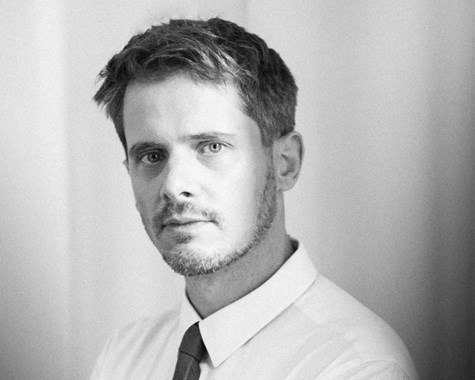
Photograph of Gregory Spears by Dario Acosta
Comments are closed.